Wednesday, 4 June 2008

good news


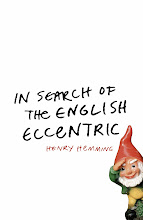
For the first time in what seems like ages Pete Doherty, one of the stars of In Search of the English Eccentric, was in the tabloids without being portrayed as the drug-addled unwashed Son of Sam that some red tops like to make him out as. The story was about the fact that he had to bury one of his cats before going onstage.

Tuesday, 3 June 2008

Gin the dog

This made me happy when I read it. it's from a longer piece in praise of 'Britain's Got Talent' by Kira Cochrane, and is in fact the first time I've read or heard someone else say point out what I seemed to find throughout researching In Search of the English Eccentric:

'In Britain, it is usually only upper-class eccentricity that is celebrated and recognised, but Britain's Got Talent shows that eccentricity lurks in all corners of the land, and that it is entertaining, shameless, and often hilarious. While it might seem strange that a 74-year-old cleaner would want to dress up in a leotard and lie on a bed of nails, for instance, Joan Gallagher seemed to enjoy every minute in the spotlight. The programme offers up the weirdest acts - people who dance with illuminated hula hoops, in superhero costumes; who perform the Star Wars theme tune on a keyboard - re-arranged to make it more "spacey"; who whistle Nessun Dorma; who bring ferrets on stage to dance, and then have to hurry them off when they start trying to mate. Most respond well to the adversity of the judges; when Simon Cowell dubbed 20-year-old student Donald Bell-Gam "the worst singer we have had on Britain's Got Talent - completely and utterly horrific", Bell-Gam simply paused before responding with a screeching version of I Will Always Love You. If he was fazed, it didn't show.'

And following hard on her heels, here's Melanie Reid in the Times:

'Britain's Got Talent is a model for a competitive, compassionate, cohesive, colour-blind society that the politicians haven't quite managed to deliver. Telly got there before them. The show taps straight into some wellspring of happy ordinariness. It is endearing because it's an snapshot of British life: unpredictable; inspiring; sentimental; humorous: a celebration of national eccentricity. '

Monday, 2 June 2008

More eccentric summer games

If you liked the Cheese-rolling at Cooper's Hill, near Gloucester, then you'll want to know about the nearby Olimpick Games, a little to the west in Chipping Camden. They took place this weekend.

Here's a report of this year's games, but much better is this clip from last year's games showing the highlight of the Cotswold Olimpicks, shin-kicking..

Sunday, 1 June 2008

Dead Eccentric no. 1

I thought I'd start with an eccentric who's in the news right now. Even if he never existed. He's an imaginary eccentric Victorian inventor - constructed by artist Paul St George as part of his Telectroscope installation that opened recently on the banks of the Thames.

The fact that he never was makes him doubly interesting for me, as he becomes an amalgam of the different things we want an English eccentric to be.

Alexander Stanhope St George 1848-1917

...was a little-known eccentric Victorian engineer. The first of seven children (it's interesting how eccentrics are almost always the first of their siblings) he was born to a British father and a Sierra Leonian mother. Aged nine, he went to see the attempted launch of Isambard Kingdom Brunel’s Great Eastern steamship. This is where this photograph was taken. Although he was cropped out of the image we routinely associate with this great inventor, St George never forgot this moment and would claim Brunel as his greatest inspiration.

After university St George went to work with some of the great engineers of the time, including Joseph Bazalgette (Chelsea Embankment), John Wolfe-Barry (man behind the the District Line) and Sir John Hawkshaw (Severn Tunnel).

In 1884 he went to New York to see the newly completed Brooklyn Bridge. Again, he was wowed. On his way back there was an unscheduled stop at a mid-Atlantic island. This would go on to provide the inspiration for his greatest invention: the telectroscope. It was to be a transatlantic tunnel in which you could travel without moving. His contraption would be a “device for the suppression of absence”: an optical machine which allowed you to see from one end of the tunnel to the other.

So he returned to the mid-Atlantic island and had a shaft sunk. Teams of men dug in opposite directions, one lot heading to London, the rest to New York.

But the project was bedeviled with delays and accidents. Meanwhile St George began to lose his mind.

Four years after it began his workforce mutinied and forced St George to take them back to England.

He never recovered from the sense of disappointment that followed. His mental health continued to deteriorate and in 1917, resident in a Bethnal Green asylum, he died. His family tried to suppress his papers and pretend that he didn’t exist until recently when his great-grandson, Paul St. George, found them.

Where? In an attic of course.

Here’s the Brooklyn end of the telectroscope he was able to build having got his hands on Alexander Stanhope St George’s designs.


I really wish he had existed. He feels at least half-real.

Thursday, 29 May 2008

Vivienne Westwood show

There's a show that opens today in Sheffield, at the Millennium Gallery, dedicated to the work of Dame Vivienne Westwood: it's a retrospective of her clothes, a monument to her status as grand dame of British fashion.

Typical of most of the Vivienne references I found while researching the chapter on her in In Search of the English Eccentric is this: "She is one of the most original voices in 20th century fashion," says Claire Wilcox. "She never swam with the tide. In 100 years' time I still think her work will be strong and will speak for itself."

I agree. Although it's a shame that the show doesn't seem to focus on Vivienne herself, and what she stands for. For more, see her manifesto.

Wednesday, 28 May 2008

Bankesy

Here's an interesting piece from the Jerusalem Post all about the ruins of Qasr al-Abd, west of Amman, capital of Jordan, brought to the attention of the world by 'an eccentric English aristocrat', William Bankes. Orientalist, Egyptologist, collector and mate of Lord Byron, Bankes recognised these ruins as being those of Tyros, described by the 1st century AD Jewish historian Josephus, when he came across them along with two British naval officers midway through a grand tour of the world.

Although he was mostly responsible for redesigning Kingston Lacy and leaving it in the shape it is in today, Bankes barely got to live in or enjoy his creation. He was forced to flee the country and live more or less in exile after he was caught in flagrante with a guard in Green Park. Sodomy, at the time, remained a capital offence.

Throughout his life he sent back to Kingston Lacy numerous artefacts or curiosities that he picked up on his travels, and is said to have returned home in secret to glimpse this collection just before he died.

Tuesday, 27 May 2008

Without doubt England's most eccentric sporting fixture

I have no idea why, but this makes me extremely happy. Yesterday the legendary cheese-chasing event took place at Cooper's Hill in Gloucestershire. I wish I'd been there. Instead, here's a video of it, something I could watch (and have watched) again and again...